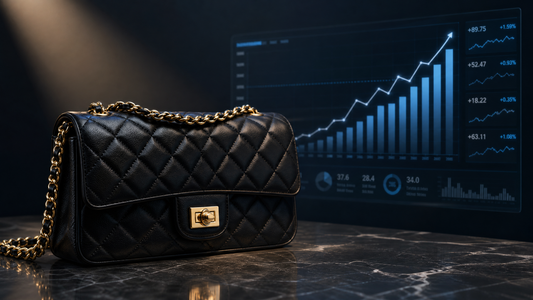
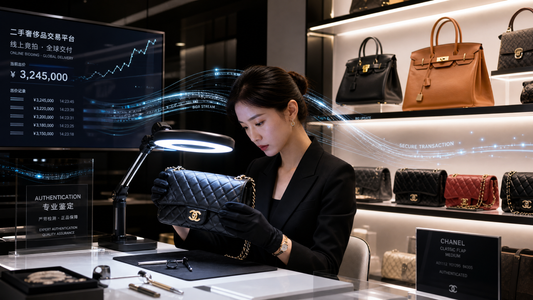
As the President of the Asia Luxury Association (ALA) and a practitioner running a Chanel vintage business in Hong Kong, I deal with the authenticity challenges of the second-hand luxury market every single day. Recently, the AI authentication platform Entrupy released its "State of the Fake 2026" report. The data within not only confirms our daily industry observations but also reveals a profound transformation occurring across the entire luxury authentication landscape. The report highlights that out of $3.34 billion worth of goods authenticated in 2025, despite the AI system boasting a 99.86% accuracy rate, a significant 8.1% of luxury items were still flagged as "unidentified." This means that even top-tier AI, equipped with 90 million reference images, is hitting a bottleneck when faced with today's "Superfakes."
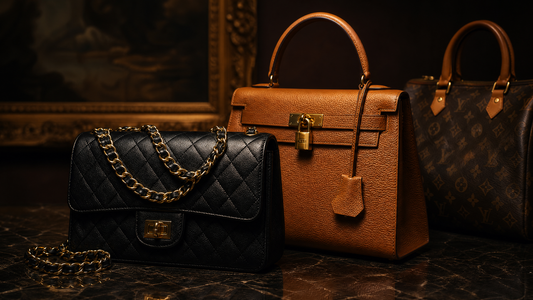
Among the various brands, Louis Vuitton remains the most counterfeited brand submitted for authentication, accounting for 33.14% of the total. Gucci follows closely, with over $17.8 million worth of fake bags submitted in 2025 alone. The total resale value of counterfeit Chanel items is even more staggering, exceeding $500 million the previous year. However, the data that alarms me the most is regarding Goyard. Although Goyard items only made up 1% of the total submissions, a shocking 18.9% of them were flagged as fake. For us dealers in Asia, this is a massive red flag that demands our utmost attention. It demonstrates that for relatively niche brands or those with smaller submission volumes, the hit rate for fakes can be exceptionally high, and a slight oversight can lead to substantial losses.
Looking back over the past five years, luxury handbag authentication technology has indeed made significant strides. For instance, after March 2021, Louis Vuitton abandoned traditional printed date codes in favor of embedding invisible NFC and RFID microchips. The LVMH group also launched the AURA blockchain platform, attempting to establish a complete tracking path for handbags from the tannery to the point of sale. These technologies have undoubtedly raised the barrier to counterfeiting significantly. However, raising the barrier does not equate to completely closing the loophole. Sophisticated counterfeiters have already begun installing fake RFID chips into replicas. While these fake chips cannot connect to the brand's private blockchain, if no one performs a deep database cross-check, the mere presence of the chip is often enough to pass inspection. This also reminds us that vintage items from before 2021, lacking the support of these modern technologies, rely even more heavily on the manual authentication experience of our industry professionals.
The second-hand luxury market, especially in Asia where cross-border circulation is frequent (e.g., sourcing in Japan, trading in Hong Kong, selling in China), is exactly where authentication technology faces its most rigorous tests. A brand-new handbag purchased at an authorized boutique has a clear chain of custody. But after it has passed through three owners and crossed two continents, that chain is broken. Resale platforms, consignment stores, and second-hand dealers like us become the frontline absorbing this risk. Every counterfeit item circulating in the resale market, whether misjudged or not, erodes the pricing power and consumer trust that brands have built in the primary market. This is precisely why the ALA is dedicated to building a resource-matching and industry-trust network. When the chain of custody is broken, cross-verification and trust among peers become absolutely crucial.
So, what is the next step for authentication technology? Current chips and blockchain records are essentially still "claims layered on top of the object," rather than "proof embedded within the object." Paper certificates can be copied, and chips can be forged, but physical markers applied to the material itself are incredibly difficult to compromise. This is the new direction proposed by physical verification solutions like Haelixa: applying DNA markers to leather, thread, or hardware at the manufacturing stage. These markers are invisible, harmless, and designed to withstand the processes of use, repair, and resale. They do not rely on a chip remaining intact, nor do they depend on a database connection; they rely solely on the physical testing of the material itself. If this DNA marker technology becomes widespread in the future, it will undoubtedly be implemented at the brand level first, and we second-hand dealers must understand and adapt to this trend early on.
In conclusion, luxury handbag authentication is in a constantly escalating arms race. AI scanning, chips, and blockchain—each layer of defense raises the bar, but no single feature can bear the entire weight of an authenticity claim alone. The 8.1% "unidentified" rate clearly tells us that AI is not a panacea, and human experience remains irreplaceable. This is exactly where the professional value of our ALA members lies. My pragmatic advice to all industry peers is this: insist on multi-layered verification. Combine AI scanning, expert visual inspection, source document review, and peer cross-verification. Never bet your judgment of authenticity on a single feature. Only by doing so can we navigate steadily in this challenging market.
Want to learn more about the latest trends and professional authentication knowledge in the second-hand luxury market? Visit the Asia Luxury Association website at aisaluxassoc.com, join our industry trust network, and let's elevate industry standards together.